

This Star Fox 1993 Linux technical audit explores how Argonaut Games pushed the Super Nintendo’s hardware limits. We test original code performance, Super FX chip emulation, and how the game’s erratic frame rate behaves on modern systems.
Star Fox (1993) At a Glance
Release Date
Feb 21, 1993 (JP)
Mar 23, 1993 (NA)
Star Fox (1993) Background
Star Fox first broke cover in January 1993 at the Consumer Electronics Show in Las Vegas, showcasing a bold, unproven concept. The rail shooter launched on February 21, 1993, for the Super Famicom in Japan, landing on North American shelves on March 26, 1993, before making its way to Europe on June 3, 1993.
Speaking with Time Extension in an interview conducted by Damien McFerran, Argonaut Games founder Jez San laid out the absolute grind of squeezing real-time 3D polygons out of stock 16-bit hardware. This pivotal moment in Argonaut Games history required the British engineering squad to reverse-engineer the SNES from scratch without official documentation to survive Nintendo’s high design standards.
They utilized a custom co-processor inside the cartridge to handle polygon math independently of the main console CPU. This chip acted as a dedicated 3D pipeline, drawing flat-shaded models the core system could not process alone. While the coders stripped out everything they could to protect the 21MHz clock line, Shigeru Miyamoto’s rigorous feedback kept the game’s actual feel locked down tight.
The development team for Star Fox (1993) includes:
- Dylan Cuthbert (Programming)
- Star Fox 2, X, Star Fox 64 3D
- Katsuya Eguchi (Director)
- Wave Race 64, Animal Crossing, Star Fox 2
- Takaya Imamura (Graphic Designer)
- F-Zero – F-Zero GX, Star Fox – Star Fox Zero, The Legend of Zelda: Majora’s Mask
- Hajime Hirasawa (Composer)
- Star Fox, Wave Rave
- Shigeru Miyamoto (Producer)
- The Legend of Zelda series, F-Zero series, Mario series
- Hiroshi Yamauchi (Executive Producer)
- Sin & Punishment series, F-Zero – F-Zero X, Star Fox – Star Fox Adventures
Star Fox (1993) Experience
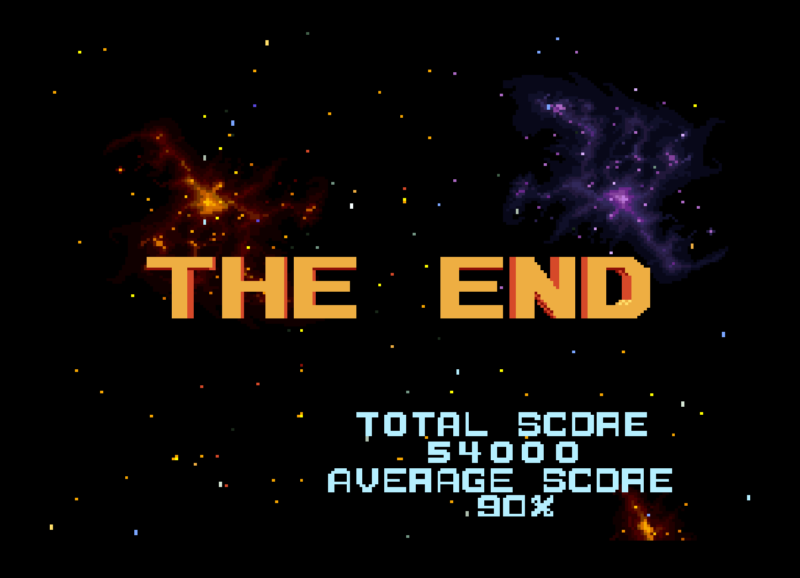
I first played Star Fox back in 1999 but never fully completed it, as it was a borrowed cartridge I had to quickly return. Coming back to the cockpit after decades away, especially with the polished mechanics of Star Fox 64 fresh in my mind, offers a reality check. Quality-of-life functions like d-pad shortcuts for somersaults and U-turns do not exist here, as those maneuvers were not introduced until Star Fox 64. For this audit, I stripped away modern comforts and evaluated the original to see exactly how well this entry holds up today.
Star Fox (1993) Impressions
Introduction
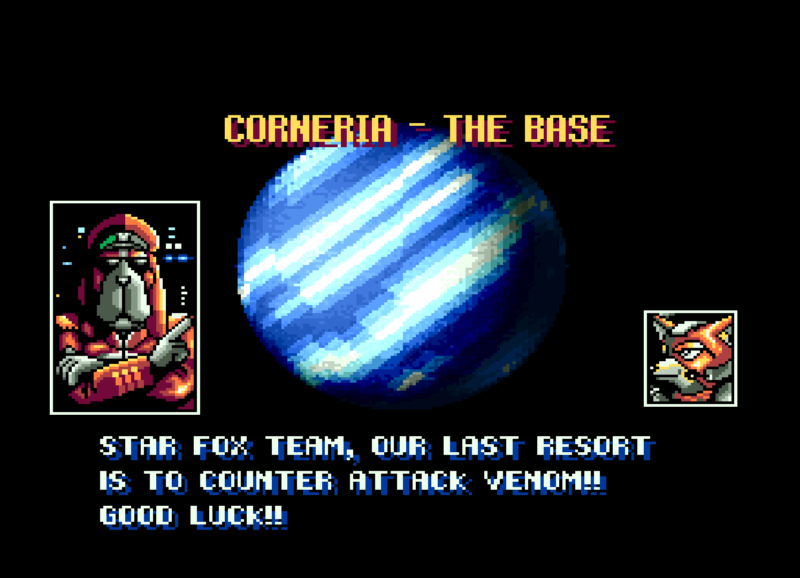
The second you drop into the cockpit of the Arwing, you realize exactly how much heavy lifting the hardware is doing. The game dumps you straight into a world made entirely of flat-shaded polygons instead of traditional 2D sprites. It forces you to completely rethink how you judge distance and depth on an older console, trading the lush, detailed art of the 16-bit era for a stark, mesmerizing digital void.
Gameplay & Mechanics
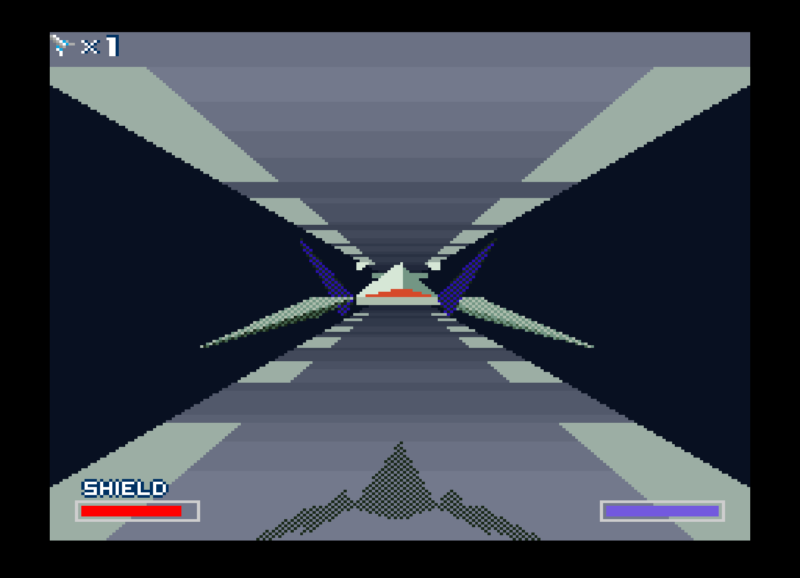
Corridor Rail Shooter Structure
The game locks your Arwing onto a fixed forward path. You manage your position and slam on the thrusters or speed brakes to squeeze through tight geometric corridors, making every run feel like a high-speed flight check.
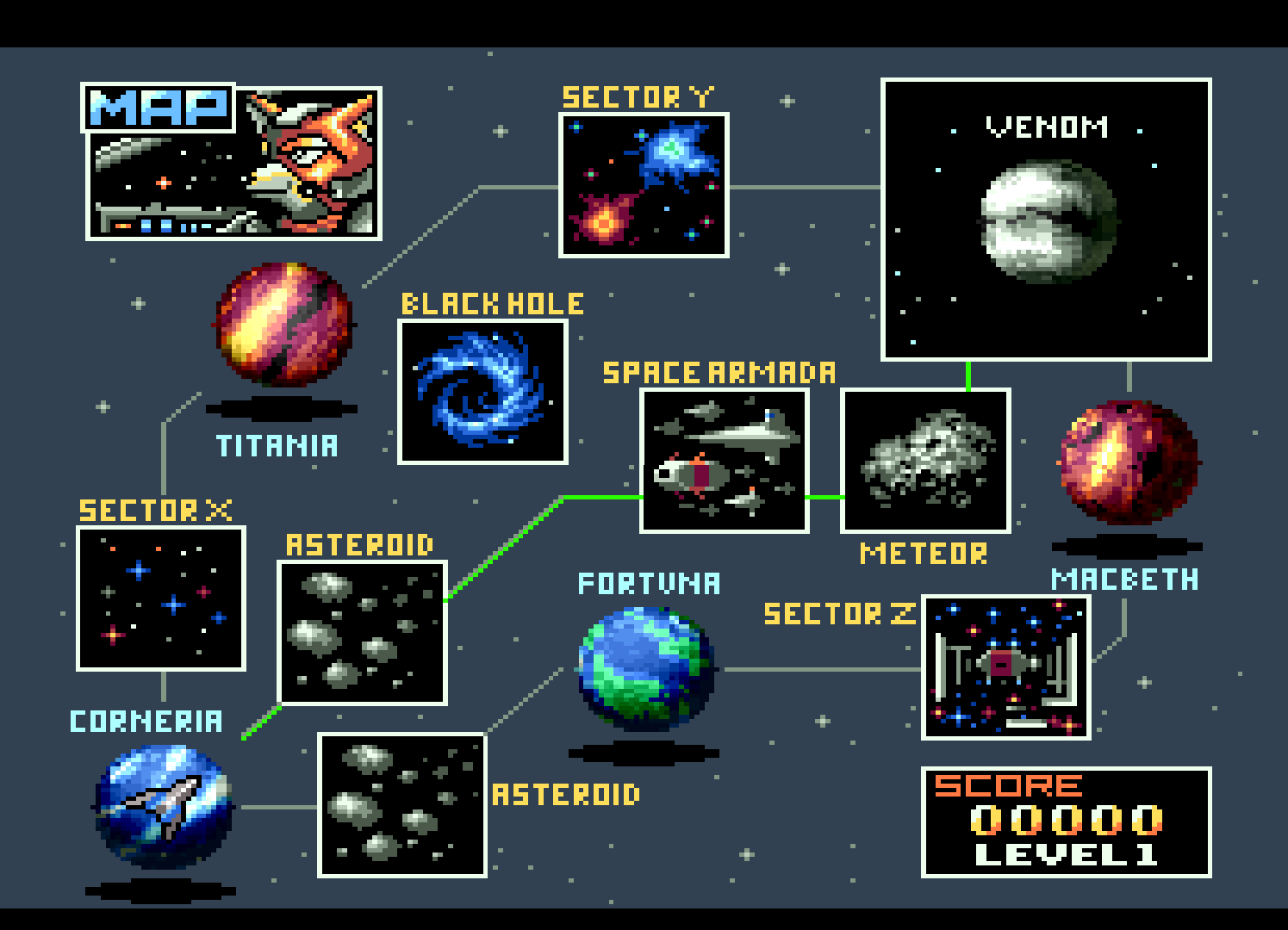
Branching Difficulty Paths
The map screen divides Corneria’s defense into three separate flight paths. Selecting your route locks you into a specific difficulty level, scaling up obstacle density and enemy aggression from a breezy patrol to a chaotic fleet battle.
Arwing Hitbox Geometry
Your ship sports a deceptively large physical footprint. Unforgiving, blocky hitboxes make navigating tight asteroid fields intense, forcing you to steer out of the way well before an object actually reaches your ship.
Boost & Brake Inputs
Manipulating your speed shifts your position forward or back on the screen. Slamming the brakes gives you extra aiming time against incoming squads, while hitting the boost slips your craft through closing blast doors just in time.
Deflective Barrel Roll
Double-tapping the shoulder buttons pulls off a rapid spin. This quick maneuver sets up a temporary invulnerability window that deflects standard enemy plasma shots right off your hull.
Wing Damage Mechanics
Clipping a wall or taking a heavy missile hit strips the Arwing of its wings. Losing a wing permanently ruins your handling and downgrades your twin lasers back to a default single-shot configuration until you find a repair ring.
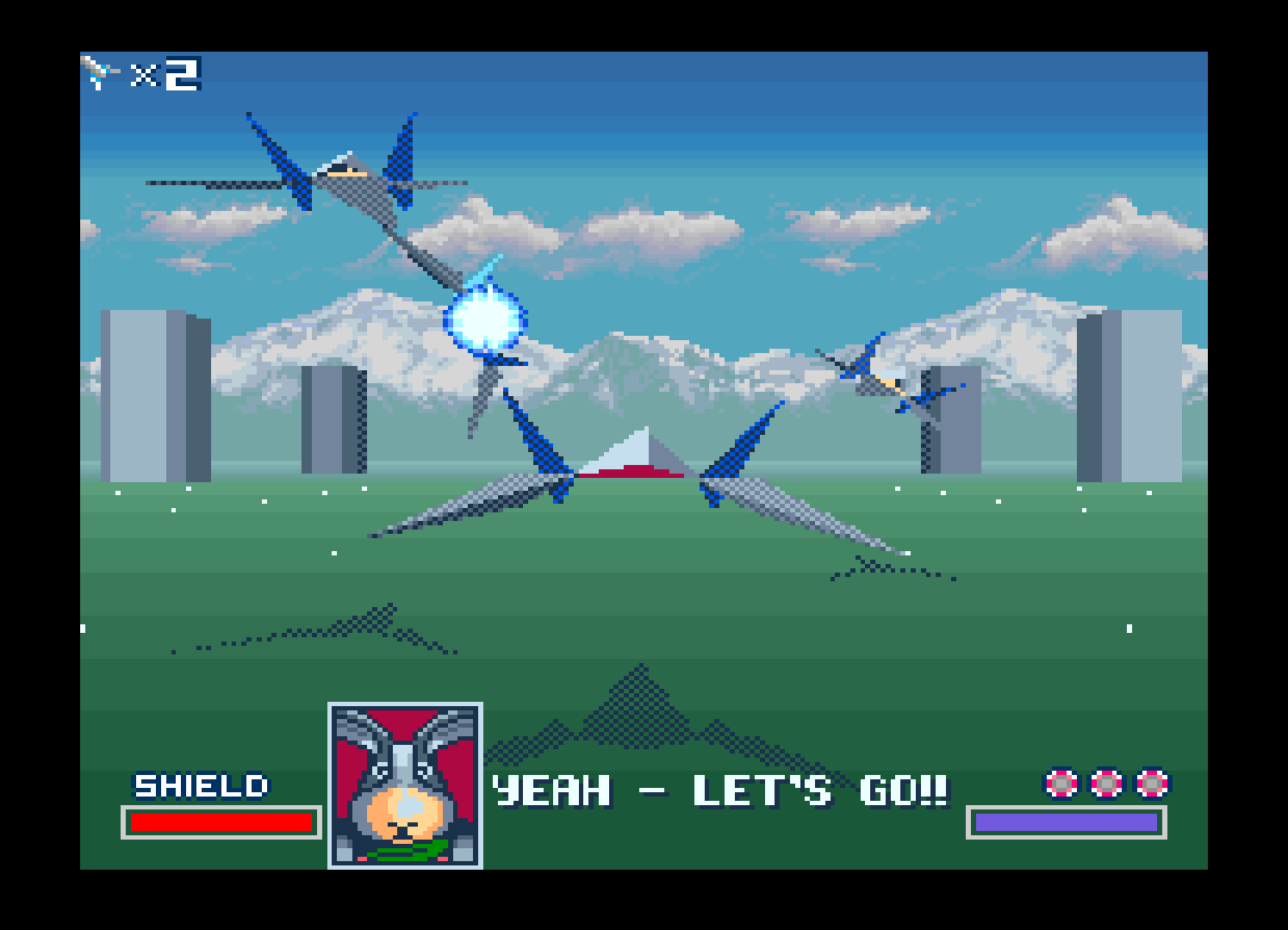
Nova Bomb Ordnance & Squad AI
Your limited secondary payload clears the immediate viewport. Detonating a Nova Bomb sweeps minor screen threats away instantly and scrambles boss shield cycles when you are completely overwhelmed.
You fly alongside three automated squadmates who constantly pull enemy aggro. Keeping tailing interceptors off their backs adds a layer of frantic management to the combat, as their permanent deaths leave you short-handed for the rest of the campaign.
Tactile Cockpit View
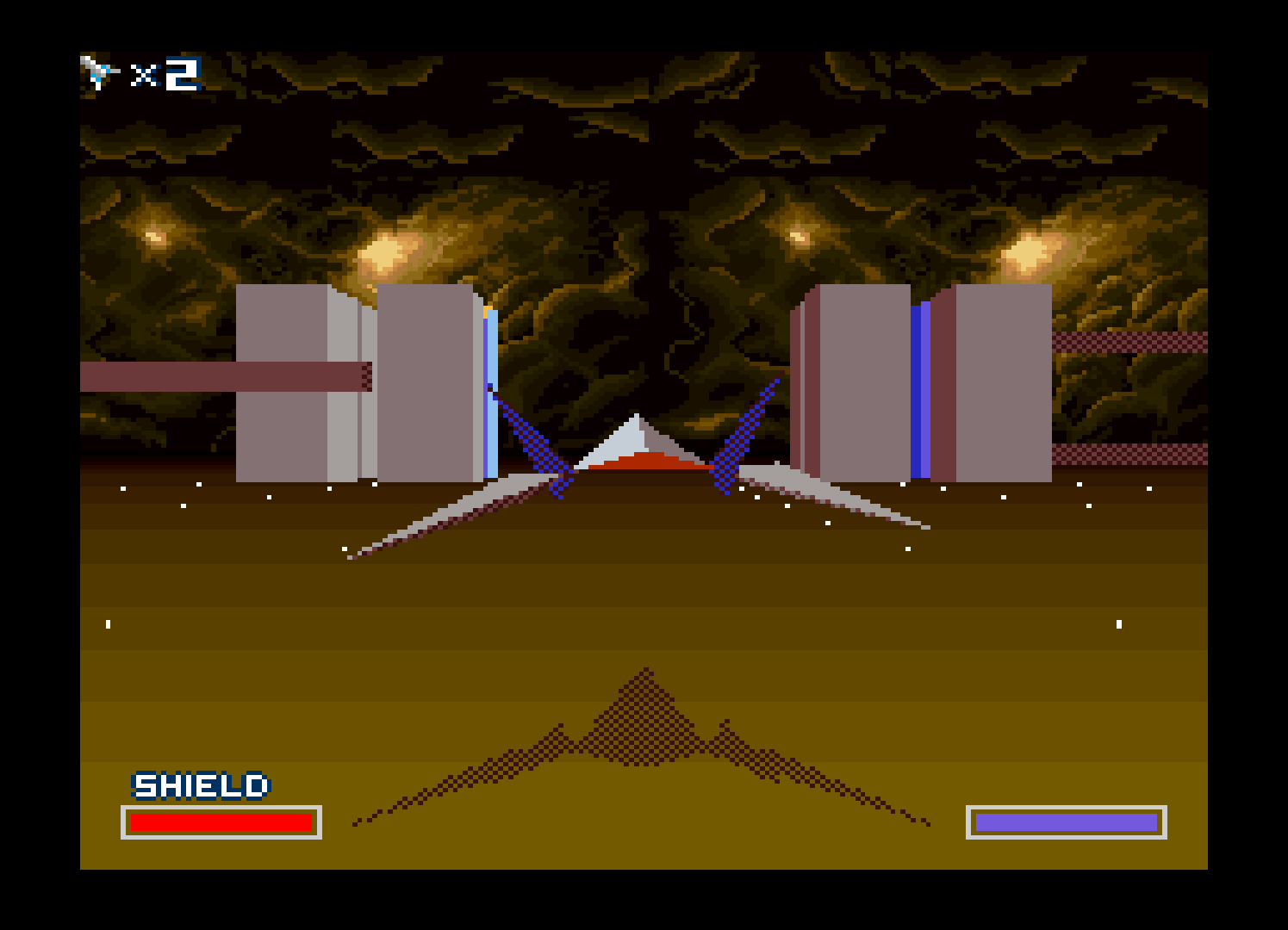
Hitting the Select button pushes the camera straight inside the ship. Hiding your ship gives the hardware a break, offering a slightly cleaner, more responsive view during dense dogfights.
This functional shift also strips away the visual clutter, allowing you to focus on the stark, geometric presentation
Art & Audio
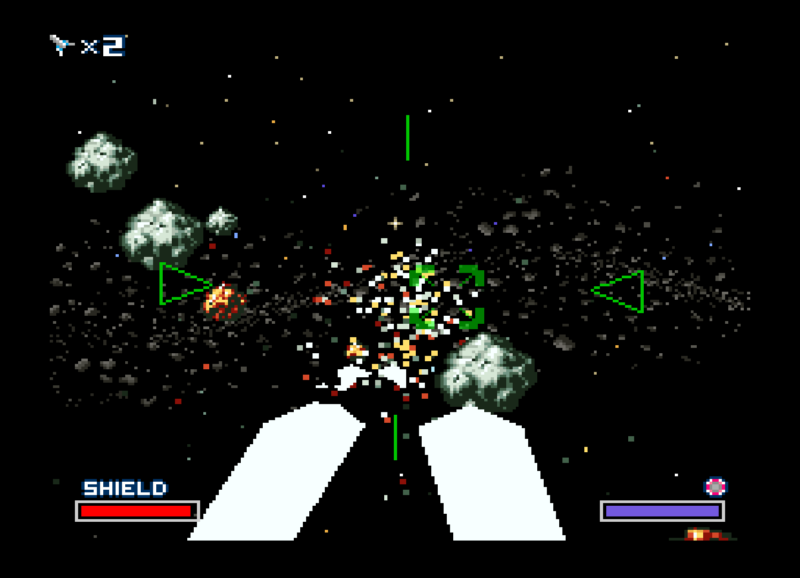
Flat-shaded polygons completely dominate the presentation. Because there is no texture mapping, the visual style relies entirely on form, scale, and color. The Arwing is a sharp, low-poly wedge cutting through a pitch-black sky. Enemies appear as primal shapes: floating prisms, spinning cubes, and giant wireframe obelisks that create a sterile, mechanical atmosphere. The palette leans into high-contrast primitives, slicing bright blues, deep purples, and warning oranges across the void to give you a sense of scale without needing traditional sprite art.
Low-frequency explosions and digitized laser fire anchor the physical feedback. The SNES hardware compresses these synthetic waveforms into punchy, crunching cues. Your lasers snap with a sharp percussive click with every press of the button. Hull hits register as heavy white-noise crunches, giving you instant confirmation that your shots connected.
Even the voice work uses an iconic phonetic garble; this rhythmic gibberish communicates panic from your wingmen without breaking your concentration. When your shield levels drop to critical, a sharp, repetitive alarm cuts through the music, providing an unmistakable audio warning during frantic dogfights.
Standout Tracks
- Corneria Theme
A propulsive, synth-driven military march. The arrangement uses excellent stereo separation to build momentum during your initial planetary entry. - Asteroid Belt
A frantic track built around rapid percussion and sharp horn samples. The arrangement ramps up the panic as floating geometric space junk crowds your screen. - Space Armada
A dark electronic theme driven by heavy bass loops. The track shifts the mood toward cold, isolating danger right before you engage massive capital ships.
Star Fox (1993) Performance
The game pushes the Super Nintendo to its absolute limits via custom hardware, but analyzing Super FX chip performance reveals that this achievement demands a massive hardware tax. Because the rendering engine scales its performance based on how many objects crowd the viewport, the actual Star Fox SNES frame rate is all over the place. The action routinely drops into the single digits and chugs to a crawl whenever the screen fills with intense particle effects, enemy fleets, or massive capital ships.
Running the original software on modern platforms highlights this erratic performance. While modern emulators run the code accurately, they also preserve the native slowdown of the cartridge. Squeezing down narrow corridors becomes an exercise in anticipating input delay during heavy frame drops rather than relying on pure reflexes.
There is no modern hardware safety net here. The SNES has a hard memory limit, so whether you play this on an emulator or original hardware, you are constantly battling variable lag spikes that turn precise positioning into a game of raw prediction.
Star Fox (1993) Audit Verdict
Star Fox (1993) is a fascinating historical artifact that demands respect for its engineering, but it is not a title that has aged with grace. Returning to the cockpit after years of experiencing the fluid quality-of-life improvements found in Star Fox 64 3D and the recent 2026 remake demo exposes a harsh reality. The original core loop is a struggle against its own hardware.
The trade-off Argonaut Software made, sacrificing frame rate for the sake of real-time 3D polygons, is a landmark achievement that defined a generation. However, the resulting performance, which I estimate frequently hovers between 9 and 13 frames per second, creates a sluggishness that modern players may find insurmountable.
The game feels heavy and deliberate by design. While I suspect the low frame rate contributes to that sense of physical mass, it also transforms the experience into a test of prediction rather than pure reflex. It has not aged like milk, but it certainly has not aged like wine. It remains a mandatory study for those interested in the history of console rendering, even if it is no longer the intuitive flight experience that defined its legacy.
Star Fox (1993) TLDR
Star Fox (SNES)
A revolutionary technical milestone for the SNES that demands appreciation for its engineering ambition. While the core loop remains intact, the aggressive hardware limitations and demanding performance tax mean this title is now better suited as a curated historical study than a fluid, modern rail shooter experience.
Tested On
CPU: Ryzen 7 5900X | GPU: AMD RX 9070XT 16GB | RAM: 64GB DDR4 | Storage: Crucial P5 Plus NVMe SSD
OS: Nobara Linux | Resolution: 1080p
Star Fox SNES Gameplay Analysis References
Interviews
- Damien McFerran, Jez San On Argonaut, Nintendo And Star Fox | 7th May 2026, Time Extension
[Live | Archive]