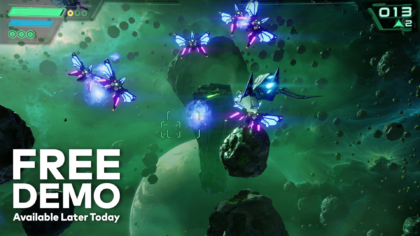


The Star Fox (2026) eshop demo delivers a systems-first look at how Nintendo and Velan Studios are translating their foundational rail-shooter design to new hardware.
Testing the demo docked on the Switch 2 reveals a clear design intent: preserving the rigid forward momentum of the classic entries while using modern hardware overhead to expand environmental scale.
Premise & Presentation
The demo opens with an animated sequence showing the betrayal of the original Star Fox team on Venom. Rather than replicating the text-scroll of the 1997 release, this sequence offers an uninterrupted look at James McCloud, Peppy Hare, and Pigma Dengar.
Showing exactly what happened to Fox’s father rather than burying it in a manual sets the remake’s pacing early. The focus remains locked on cinematic scale without slowing down the forward drive of the missions.
Controls & Mechanical Adjustments
The demo’s tutorial environment breaks down the core Arwing flight mechanics with clean, modernized inputs:
- Dedicated Somersault: Executing a vertical loop is now mapped directly to a single D-pad press, shifting the focus away from fighting the controller and placing it entirely on spatial awareness.
- Instant U-Turn: The horizontal turnaround is handled via a dedicated D-pad button. In All-Range Mode arenas, this minimizes input errors when breaking an enemy lock or pivoting toward a target loop.
- Bomb Management: Deploying smart bombs retains its original tactical weight, using clear timing to maximize splash damage against enemy clusters.
Star Fox Switch 2 60fps Performance & Behavior
Testing in docked mode shows a presentation that prioritizes fluid response times over heavy post-processing effects. The game targets an output that scales up to a reconstructed 4K presentation using a 1080p internal engine baseline, entirely managed by the software without manual option toggles.
Frame pacing remains completely smooth at a target 60 frames per second during standard flight. However, dynamic resolution scaling is active in the background. When cluster bombs detonate amidst dense geometry or heavy alpha particle effects, the internal baseline drops slightly below 1080p to guarantee the hardware maintains the mandatory 60 FPS target required for high-speed targeting without hitching.
The Meteo Mission Audit
The second half of the demo transitions directly into the Meteo asteroid field, serving as a strict technical benchmark for the engine’s physics-driven rendering.
Unlike the static obstacles of older games, the debris features active physical properties. Asteroids shatter dynamically when struck by laser fire or smart bomb detonations, creating localized, unscripted hazards. Playing through the level on normal mode allowed us to test how these basic combat interactions handle under standard conditions.
Enemy fighters utilize the dense debris field for cover, breaking line-of-sight to force defensive rolling and rapid shield management. Arwing models feature active mechanical shifts, with wing flaps adjusting dynamically based on brake and boost inputs as you thread the ship through closing gaps. The UI remains clean, positioning shield gauges and targeting reticles close to the center of the screen to minimize eye travel during high-speed maneuvers.
Closing Thoughts
Our hands-on look at this vertical slice leaves us with confidence in the remake. Coming freshly off of playing both the first Star Fox on SNES and the original Star Fox 64, the mechanical translation here feels more deliberate and grounded. The development team is modernizing input execution without losing any of the series’ core charm or feel.
We’ve already locked in the full game and plan on having our complete technical audit out as soon as next Saturday.