


Doki Doki Literature Club! proves psychological horror is most effective when players don’t see it coming. By weaponizing the conventions of visual novels themselves, it delivers one of gaming’s most memorable psychological horror experiences despite limited replay value.
Doki Doki Literature Club! At a Glance
Release Date
Sep 22, 2017
Price
Free
Proton
10.0-3
Completed on
PC
HLTB
7½ Hours (Completionist)
/ My Time: 5hrs
Beyond the Literature Club
Before Doki Doki Literature Club!, Dan Salvato had already built a reputation through projects such as Project M and FrankerFaceZ. Rather than creating another traditional dating simulator, Salvato spent roughly two years developing a visual novel that deliberately challenged players’ expectations by hiding psychological horror beneath an inviting slice-of-life presentation.
Every creative decision supports that philosophy. Artwork by Satchely, an upbeat soundtrack composed by Salvato himself, and a clean, approachable interface encourage players to settle into what appears to be a familiar school-life story. As the narrative progresses, however, those same elements become tools for building unease, allowing the game to blur the line between visual novel and psychological horror without relying on conventional scares.
Since its free release in 2017, Doki Doki Literature Club! has become one of the medium’s defining independent visual novels, demonstrating how effectively thoughtful writing and presentation can challenge expectations while remaining almost entirely spoiler-free for first-time players.

It looks like a standard club meeting, but Dan Salvato has much more in store than just afternoon poetry sessions.
Reviewer’s Perspective
Before starting Doki Doki Literature Club!, I had already completed both visual novels and adventure games such as The Silver Case, the Spirit Hunter series, and the first two Danganronpa games. Although I was already familiar with the genre, this marked my first experience with a title built using the Ren’Py engine, making me curious to see how an independent visual novel compared to the larger-budget releases I had previously played.
Reading Between the Lines
Despite being built with the lightweight Ren’Py engine, Doki Doki Literature Club! delivers an impressively polished experience. The interface remains clean and responsive, while quick saving and loading make it easy to experiment as the story gradually unfolds.
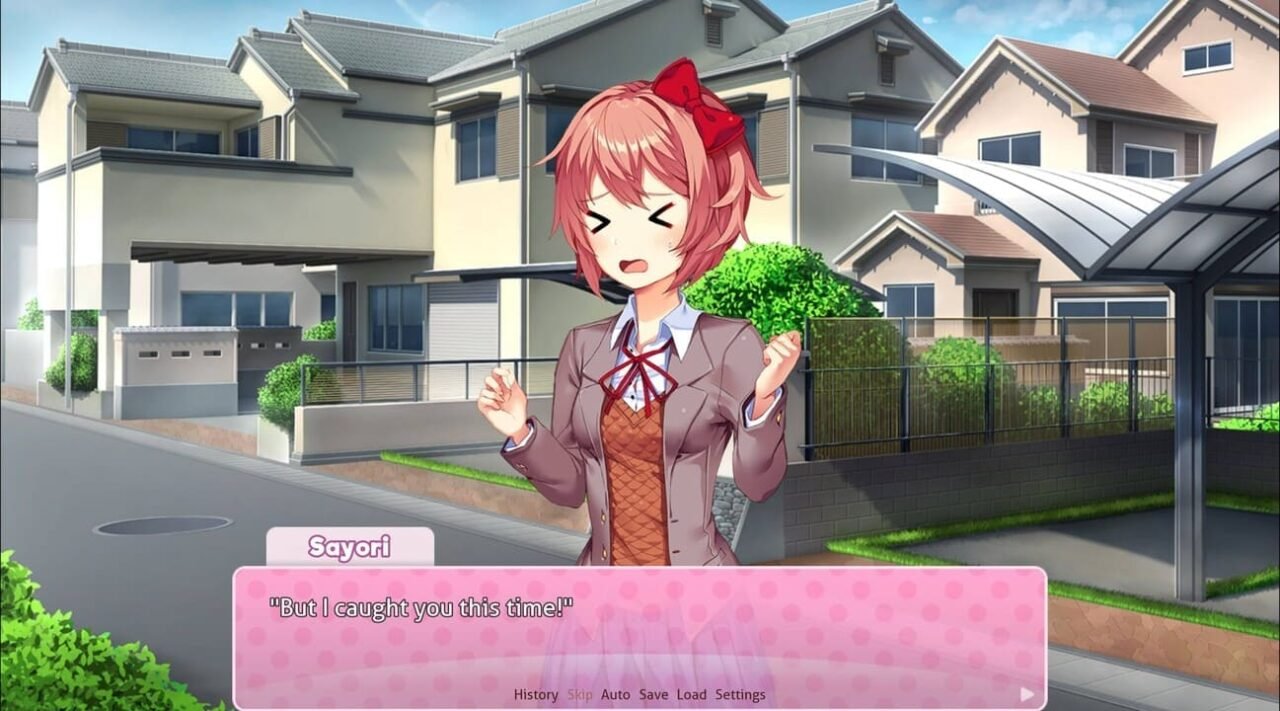
Sayori catches up with the protagonist as another member joins the Literature Club.
The poem-writing system quickly became one of my favorite mechanics. Rather than serving as a simple dialogue choice, every word you select subtly influences which club member responds most favorably, encouraging players to better understand each character’s personality without making the system feel overly complicated.
The result is a gameplay loop that feels deceptively simple while quietly reinforcing the relationships that become increasingly important as the narrative progresses.
Beneath the Smile
The greatest strength of Doki Doki Literature Club! is its confidence. Instead of relying on constant horror, Team Salvato carefully earns the player’s trust through believable character interactions, cheerful presentation, and an outstanding soundtrack before gradually revealing the darker themes hidden beneath its surface.

The game’s increasingly unstable presentation begins to reveal that something is very wrong beneath the Literature Club.
Every member of the Literature Club develops a distinct personality, making each interaction feel meaningful regardless of which route players naturally gravitate toward. The music deserves equal praise, effortlessly shifting from comforting to deeply unsettling without ever feeling forced.
Perhaps most impressive is how the narrative handles its branching structure. Rather than offering completely separate routes in the traditional visual novel sense, the game uses player choice to gradually build toward a single, cohesive conclusion that remains one of the most memorable endings I’ve experienced in the genre.
Final Verdict
Doki Doki Literature Club! succeeds because it fully commits to its central idea. Rather than simply surprising players, Team Salvato carefully builds familiarity before using the conventions of visual novels themselves to create one of the medium’s most memorable psychological horror experiences.
Its greatest surprises can only be experienced once, naturally reducing the impact of repeat playthroughs after the mystery has been solved. Even so, memorable characters, outstanding music, and remarkably confident storytelling ensure that Doki Doki Literature Club! remains one of the finest independent visual novels available and an easy recommendation for anyone interested in psychological horror.
Doki Doki Literature Club TLDR
Doki Doki Literature Club! (PC)
Doki Doki Literature Club! transforms familiar visual novel conventions into one of gaming’s most memorable psychological horror experiences.
Limited replay value is the inevitable tradeoff, but its confident writing and unforgettable atmosphere make it essential for fans of the genre.