
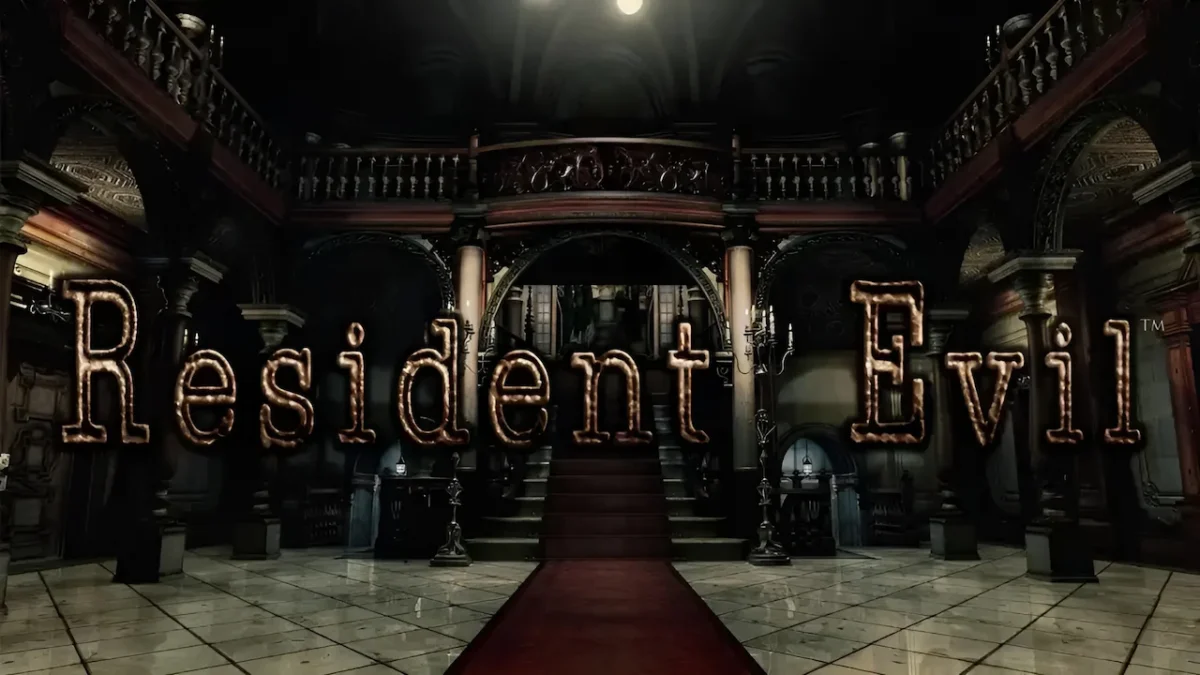
Resident Evil (2002) remake review explores why Capcom’s return to the Spencer Mansion remains one of gaming’s greatest remakes. By rethinking the original’s atmosphere, pacing, and player psychology rather than simply updating its visuals, the team created a new benchmark for the industry.
Resident Evil (2002) At a Glance
Release Date
Apr 30, 2002 (NA Original)
Jan 20, 2015 (HD Remaster)
Price
$24.99 Digital MSRP (Steam | GOG | Xbox | PlayStation | eShop)
Proton
GE-Proton10-32
Cleared
PC
/ Normal (Mountain Climbing)
HLTB
11½ Hours (Main Story)
/ My Time: 3hrs 24s
Renovating the Mansion
When Capcom released Resident Evil in 1996, the game established itself as one of the defining titles of the survival horror genre. The Spencer Mansion became an iconic setting, and the combination of exploration, resource management, puzzle solving, and cinematic presentation created a formula that would shape the series for years to come.
However, by the early 2000s, the original game had also become a product of its era. As part of Capcom’s partnership with Nintendo, the company decided to revisit Resident Evil for the GameCube, using modern hardware to rebuild the Spencer Mansion with greater detail and atmosphere rather than simply creating an enhanced port.
Director Shinji Mikami and producer Hiroyuki Kobayashi faced a unique challenge: how do you improve a game that already defined the genre without losing the identity that made it special? The goal was not to replace the original experience, but to create the version of Resident Evil that the team could only achieve with the knowledge and technology they had gained since 1996.
The Team Behind the Mansion
Resident Evil (2002) reunited many of the developers who helped define survival horror. Director Shinji Mikami returned alongside producer Hiroyuki Kobayashi to lead the remake, while planners Koji Kakae, Joesuke Kaji, and Shigenori Nishikawa expanded the mansion’s design and gameplay. Character artists Kenichi Ueda and Naoki Katakai modernized the cast’s appearance, while composer Shusaku Uchiyama crafted the haunting soundscape that helped redefine the Spencer Mansion for a new generation.
Reviewer’s Perspective
I first experienced Resident Evil (2002) in 2005 after playing Resident Evil: Code Veronica on the Dreamcast. Since then, I have followed the series through its different eras, from the classic fixed-camera survival horror entries to its later action-focused releases and modern reinventions.
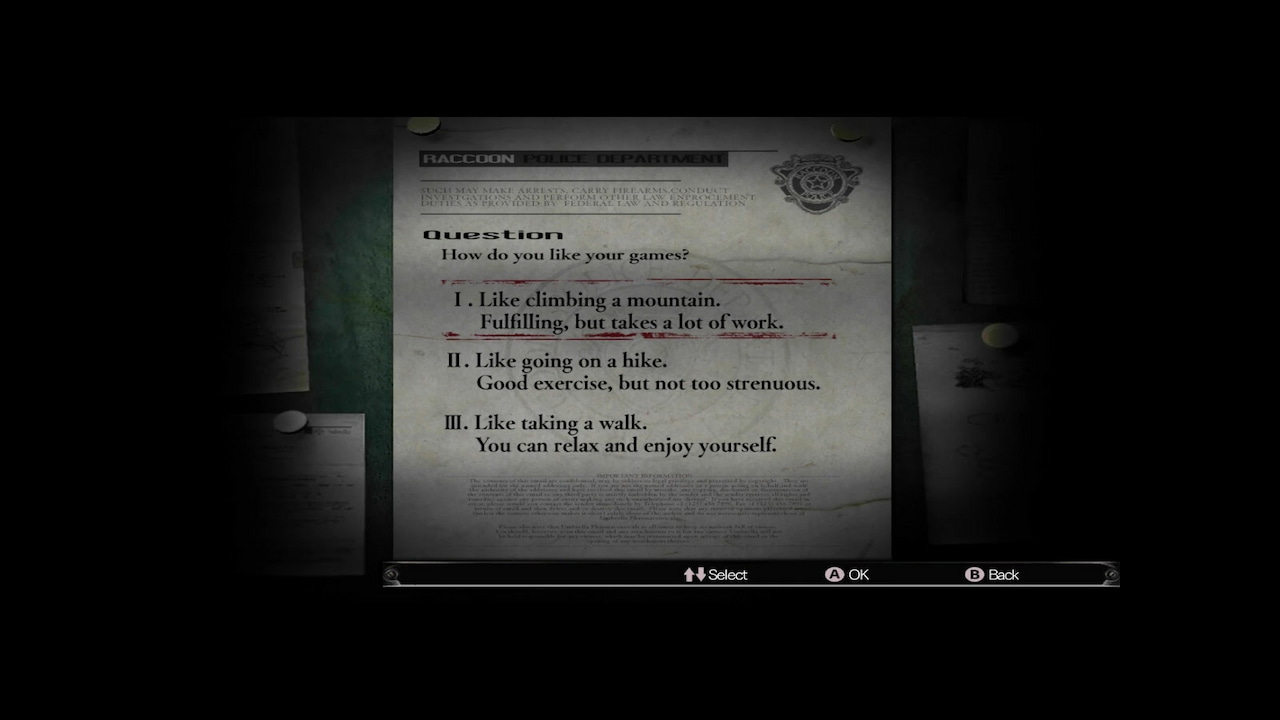
Choose your challenge level: climb a mountain, hike, or take a walk
For this review, I returned to the 2002 remake after years of familiarity with the franchise, approaching it not only as a longtime fan, but as a retrospective look at how successfully Capcom preserved the original’s identity while refining nearly every aspect of the experience.
Surveying the Scares
The Mansion Incident
After choosing between Chris Redfield and Jill Valentine, Resident Evil immediately establishes the uneasy atmosphere that defines the Spencer Mansion. The opening sequence introduces the S.T.A.R.S. Alpha Team’s investigation into the strange murders surrounding Raccoon City before abandoning the player inside one of survival horror’s most iconic locations.
Even today, the remake’s opening retains the B-movie charm of the original while demonstrating how carefully Capcom rebuilt the experience. The mansion is not simply a backdrop for the horror; it is the foundation of it, using lighting, sound, and environmental design to make every hallway feel uncertain.
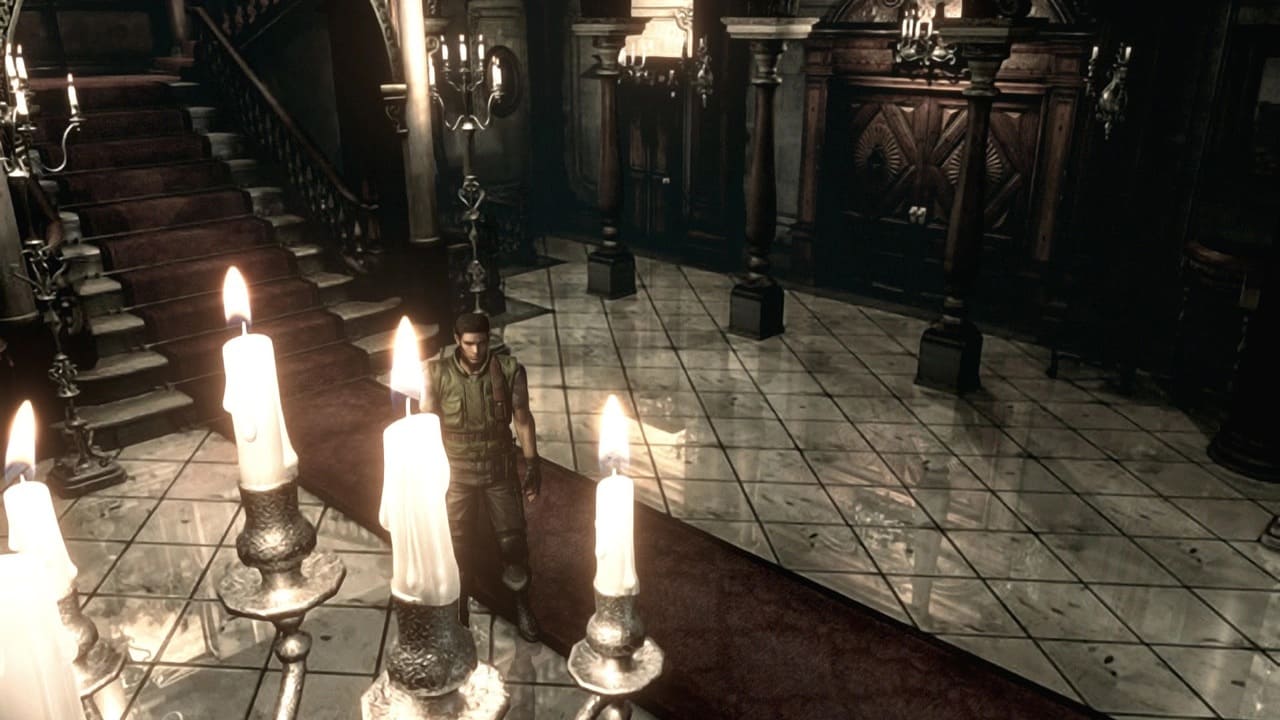
Chris stands beneath flickering candlelight in the mansion’s main hall
Survival by Design
Resident Evil (2002) is built around deliberate decision-making. Every encounter asks the player to weigh risk against reward, whether that means spending valuable ammunition on a zombie, avoiding a threat entirely, or conserving resources for what may be waiting deeper inside the mansion.
Limited inventory space remains one of the remake’s defining mechanics. Managing weapons, healing items, puzzle solutions, and defensive tools requires constant planning, turning every trip through the mansion into a calculated decision. The item box is not simply storage; it becomes part of the game’s strategy loop, encouraging players to think ahead before committing to a route.
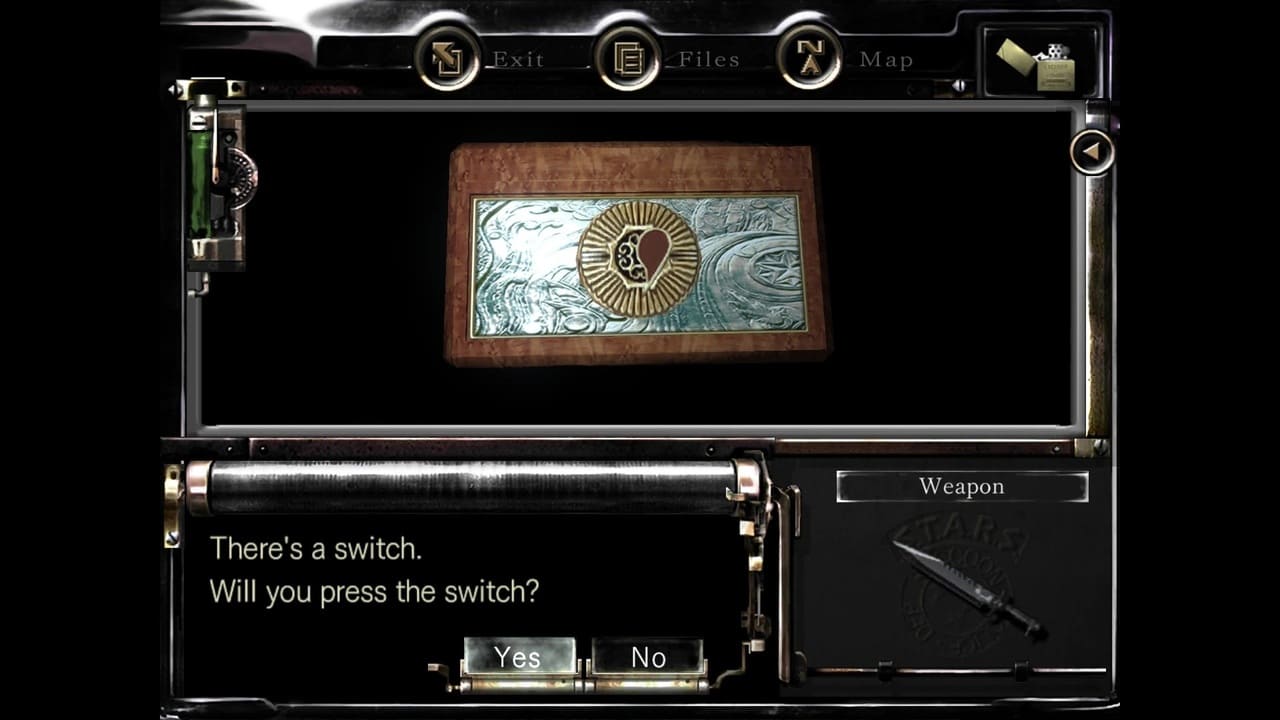
Attempting to unlock the mysterious heart-shaped box with a tense prompt.
What makes the remake’s design so effective is that it never relies on frustration for tension. The game has a specific rhythm and expects players to learn its rules, but it always gives them the tools needed to succeed. Experienced players can optimize their routes, master enemy behavior, and improve their efficiency, while newcomers can still appreciate the carefully balanced survival horror experience.
Remembering S.T.A.R.S.
The character and art design in Resident Evil (2002) balance eerie realism with stylized restraint, creating a world that feels grounded while still embracing the series’ cinematic horror roots. Chris Redfield and Jill Valentine are not helpless victims, but trained members of S.T.A.R.S. forced into an environment where their experience is constantly challenged.
That same attention to detail extends to the creatures stalking the Spencer Mansion. Zombies feel physically imposing, Hunters move with frightening aggression, and larger threats like Yawn reinforce the idea that every encounter requires preparation rather than brute force. The remake does not simply make enemies look better; it gives each threat a stronger presence within the survival horror experience.
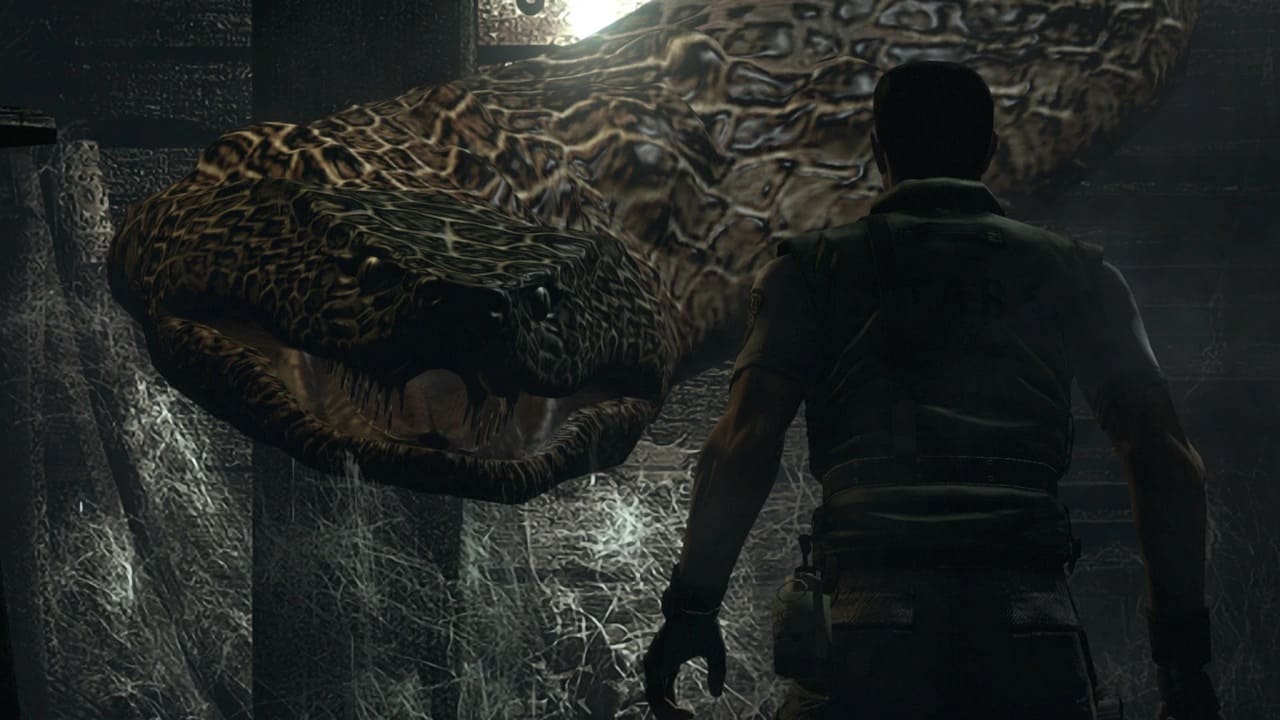
Close-up of Yawn, the snake boss, during the first attic encounter with Chris.
The Rules Have Changed
The 2002 remake introduced several mechanics that changed how players approached survival. Rather than simply recreating the original’s challenges, these additions made exploration more unpredictable and reinforced the idea that every decision inside the Spencer Mansion carries consequences.
Crimson Head Zombies: Defeated zombies can return as faster, more aggressive Crimson Heads unless their bodies are burned. This forces players to think carefully about when to fight, when to run, and which areas are worth securing permanently. The original game asked players whether a zombie was worth the ammunition. The remake asks whether killing that zombie creates a bigger problem later.
Kerosene and Body Disposal: Burning corpses requires limited fuel and inventory space, creating another layer of resource management. Removing a threat permanently can make future exploration safer, but every decision comes at a cost.
Defensive Items and Dynamic Threats: Daggers, stun guns, and flash grenades provide emergency escapes without eliminating danger. Meanwhile, certain threats can pursue players into previously explored areas, preventing the mansion from ever feeling completely safe.
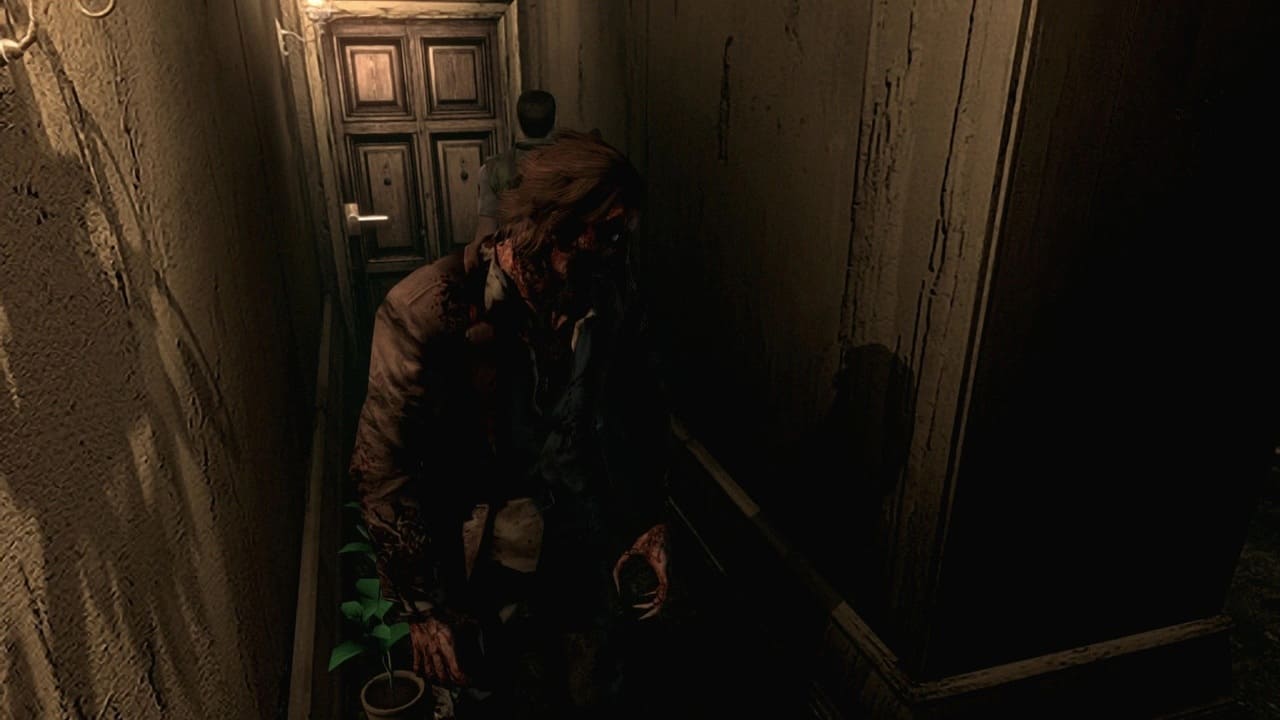
Crimson Head lurking in Cupid’s Corridor, 2F.
Unlockables
Beyond the main campaign, Resident Evil (2002) rewards repeat playthroughs with additional modes and unlockables that encourage players to master its systems rather than simply reach the credits. Whether chasing faster completion times or tackling new challenge modes, the remake offers meaningful reasons to return to the Spencer Mansion.
- Once Again: A New Game Plus variant featuring a special zombie rigged with grenades that instantly ends the game if disturbed.
- Invisible Enemy Mode: Removes visible enemies, forcing players to rely on sound cues, map knowledge, and spatial awareness.
- Real Survival Mode: Disables linked item boxes, making inventory management significantly more demanding.
- Speedrun Rewards: Faster completion times unlock powerful bonus weapons, including Barry’s Samurai Edge and the Infinite Rocket Launcher.
- Alternate Costumes: Additional outfits are unlocked through multiple completions.
Seiyuu Performances
After nearly twenty years of playing Resident Evil (2002) in English, I finally had the opportunity to experience it with the Japanese voice track. Knowing I would be reading the subtitles, I paid much closer attention to the performances and how each line was delivered. The cast approaches the material with a more grounded tone while still having fun with it when the situation calls for it. At the same time, I never felt like one language was the “correct” way to play. The English dub remains part of Resident Evil‘s identity, while the Japanese performances offer a fresh perspective for returning players. You really can’t go wrong with either.
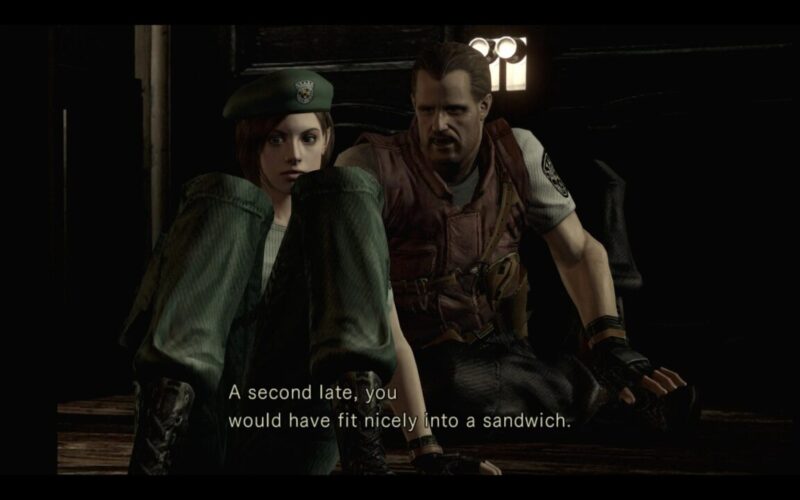
Barry saves Jill from being crushed in the iconic “Jill Sandwich” cutscene.
- Jill Valentine — Atsuko Yuya
Notable roles: Miwako Sato (Detective Conan), Anya Stroud (Gears of War), Zamira Tchaikoskaya (Tiger & Bunny 2) - Chris Redfield — Hiroki Tochi
Notable roles: Pantherlily (Fairy Tail), Nathan Drake (Uncharted), Ovan (.hack//) - Barry Burton — Yusaku Yara
Notable roles: Jiraia (Gintama Rumble), Lord Slug (Dragon Ball), Space Demon King (Super Robot Wars) - Rebecca Chambers — Ami Koshimizu
Notable roles: Holo (Spice & Wolf), Mai Shiranui (The King of Fighters), Ibuki Mioda (Danganronpa) - Albert Wesker — Joji Nakata
Notable roles: Alucard (Hellsing), Kirei Kotomine (Fate), Sol Badguy (Guilty Gear)
Final Verdict
Resident Evil (2002) is a masterclass in how to approach a remake. Rather than simply updating the original, Capcom rebuilt the Spencer Mansion with a deeper understanding of tension, atmosphere, and player psychology. Additions such as Crimson Head zombies, expanded exploration, and refined resource management strengthen the survival horror experience while preserving the identity that made the original so memorable.
More than two decades later, Resident Evil (2002) remains one of the strongest examples of a remake surpassing its source material without replacing it. It stands as a rare achievement where a development team was able to revisit its own work, understand what made it special, and create the definitive expression of that original vision.
Review Summary
Resident Evil (2002) (PC)
Resident Evil (2002) is the definitive survival horror remake. Every addition, from Crimson Heads to the redesigned Spencer Mansion, strengthens the original vision instead of replacing it.
Its deliberate pace and resource management may not appeal to everyone, but for players willing to embrace its philosophy, it remains one of the finest examples of game design and remake craftsmanship ever created.
Tested On
CPU: Ryzen 7 5900X | GPU: Nvidia 3080ti 12GB | RAM: 32GB DDR4 | Storage: Crucial P5 Plus NVMe SSD
OS: Windows 11 x64 | Resolution: 1080p | Settings: High
References
- GoldMetalSonic. (2022, January 31). Resident Evil (GameCube) – E3 2002 Trailer (DVD Rip) 4K60 Upscale. YouTube. https://www.youtube.com/watch?v=DRGz9TAo1pU
- Doughboy. (2002, April 5). Future of Resident Evil and game craftsmanship. Interview of shinji mikami resident evil re-make 1. https://survivhor.biohazardfrance.net/morbidcreations/re_behind/int_remake/int_remake_1.htm