

The indie label in 2026 is undergoing a crisis of identity. What used to signify financial independence now serves as an aesthetic for conglomerates. We must distinguish between developers working in small teams and studios backed by billionaire capital.
The term triple-i provides the classification for games that occupy the space between independent spirit and corporate scale.
Highguard & The Tencent Shadow
Highguard is the most recent example of this identity crisis. Launched in January 2026, the game was pitched as an independent project from ex-Respawn talent. Reports from February 2026 proved Tencent was the lead financial backer. This funding was contingent on metrics the game failed to meet.
Within two weeks, Tencent pulled the plug, resulting in mass layoffs. Classifying a project like this as ‘indie’ is fundamentally misleading. It utilizes the cultural capital of the independent scene to shield a product dependent on a global conglomerate.
Mixtape’s Corporate Safety Net
Mixtape represents a different form of label appropriation. Developed by Beethoven & Dinosaur and published by Annapurna Interactive, the game faced backlash for its lack of traditional mechanics. Annapurna Interactive is a division of Annapurna Pictures, founded by Megan Ellison. Public financial records confirm her father is Oracle co-founder Larry Ellison, whose net worth exceeded $200 billion in early 2026.
This relationship radically alters the profile of financial risk. Larry Ellison previously stabilized the company when debt levels became critical. A developer supported by such immense capital operates within a corporate safety net. While the creative team may remain small, the financial structure is indistinguishable from traditional prestige publishing. Using the indie label in 2026 for Mixtape suggests a level of financial precarity that does not exist at the structural level.
The 10/10 Consensus Machine
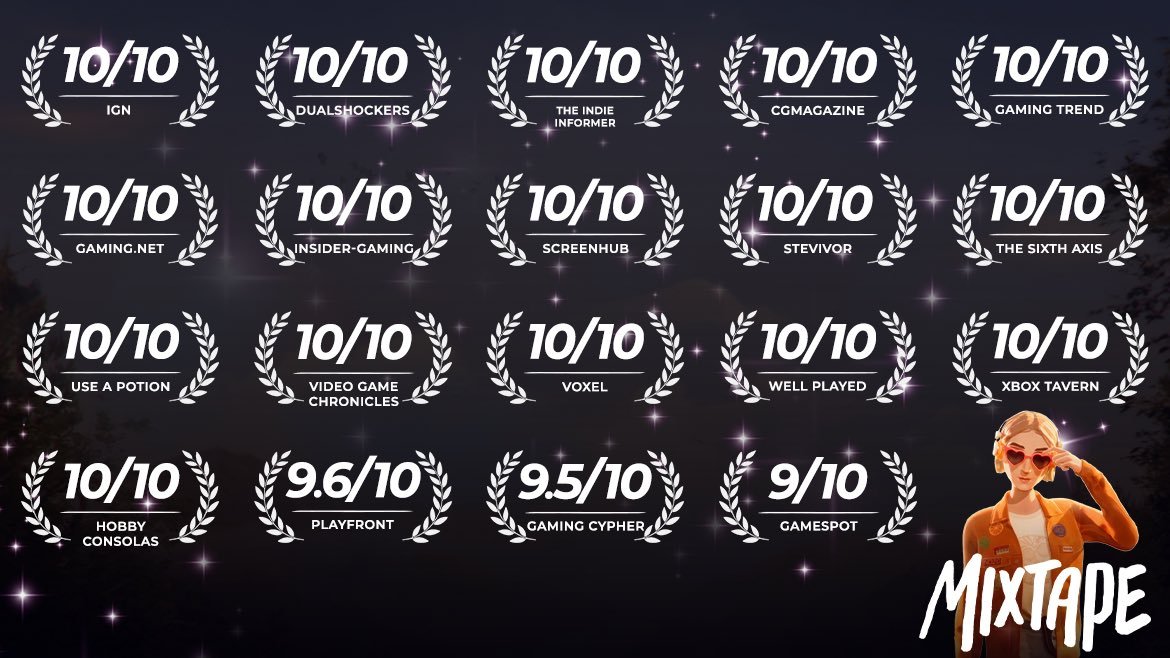
The critical reception for Mixtape was nearly unanimous. As seen in the accolades graphic above, outlets like IGN and VGC provided perfect scores. This uniform praise makes it harder to argue the reviews are purely objective. These outlets are grading on a curve, treating ‘indie-coded’ aesthetics with a reverence they would never show a AA project with the same mechanical limitations. This lack of critical distance obscures the mechanical limitations of the product, resulting in an audit that prioritizes aesthetic markers over functional technical scrutiny.
Prestige Debt & The Hundred Line
The Hundred Line represents the “Prestige Debt” end of the triple-i spectrum. Too Kyo Games took out massive loans and entered a 50/50 funding split with Aniplex, a Sony subsidiary. While Too Kyo Games assumed significant liability through these loans, the 50/50 split with a Sony subsidiary provided a marketing apparatus and distribution safety net that remains out of reach for traditional independent studios.
The Three Classes of Triple-I
To categorize these titles, we can look at three different ends of the spectrum:
| Category | Definition | Example |
| Prestige Debt | Veterans using status for 50/50 corporate splits. | The Hundred Line |
| Massive Scale | Production budgets rivaling AAA Western titles. | Black Myth: Wukong |
| Corporate Shadow | Underlying capital provided by giants like Tencent. | Highguard |
The Million Dollar Barrier
Most developers who are truly independent cannot afford these slots. When Geoff Keighley introduces an ‘indie’ segment, he is introducing games with budgets large enough to spend a million dollars on three minutes of airtime. This creates a feedback loop where only corporate-backed titles receive the ‘indie’ spotlight.
| Trailer Duration | Estimated Cost |
| 60 Seconds | $450,000 |
| 180 Seconds | $1,000,000+ |
What Can Be Done?
We should stop using art style to define a developer’s status. If a game is funded by Tencent, backed by billionaires, or promoted with million-dollar trailers, it belongs in the triple-i category. Continuing to ignore this distinction allows the media to act as an uncritical extension of corporate marketing departments. Acknowledging the triple-i category is the only way to restore analytical distance.
Indie Label In 2026 Sources
- Tencent Secretly Funded Highguard | Game File, Feb 17, 2026 [Live | Archived]
- Larry Ellison Profile | Forbes, May 12, 2026 [Live | Archived]
- Mixtape Review: A Musical Delight | IGN, May 7, 2026 [Live | Archived]
- Mixtape Review: The Coming-of-Age Standard | VGC, May 7, 2026 [Live | Archived]
- Danganronpa Creators are ‘risking their lives’ for their new game, which has put them in debt | AUTOMATON, June 19, 2024 [Live | Archived]
- The Game Awards Trailers Can Cost Devs up to $1 Million | GameDeveloper, Dec 11, 2025
[Live | Archived]