Doki Doki Literature Club! combines charming visuals with psychological horror, strong characters, a haunting soundtrack, and a cleverly subversive story. Unexpected twists and a cohesive true ending create a powerful impact throughout the narrative on PC.
It remains a compelling experience for visual novel fans who enjoy deep psychological themes in their stories.
Doki Doki Literature Club
Released: September 22nd, 2017
Developer(s): Team Salvato
Publisher(s): Team Salvato
Platforms:


Completed on Steam, all endings obtained. Doki Doki Literature Club is free and can be legally obtained here.
HowLongToBeat Time: 4 hours | My Clear Time: 5 hours
Doki Doki Literature Club Background
Dan Salvato of Team Salvato spent two years developing Doki Doki Literature Club! after making a name for himself with Project M and FrankerFaceZ. Salvato wanted to flip standard visual novel tropes on their head, using the cute exterior to hide heavy themes like mental health and existential horror. With art by freelancer Satchely and a soundtrack composed by Salvato himself, the game does a great job of shifting from a cheerful school vibe to something much more unsettling.
Since its free release on Steam in September 2017, it has become a cult classic. People were caught off guard by its psychological depth and the way it breaks the fourth wall, making it a massive standout in the genre.
Doki Doki Literature Club Experience
Before starting DDLC, I had already cleared several visual novels like the Spirit Hunter series, The Silver Case, and the first two Danganronpa games. As for the Ren’Py engine, this was my first time knowingly playing anything built with it. I went in curious to see how it compared to the higher-budget titles I usually play.
Doki Doki Literature Club Impressions

It looks like a standard club meeting, but Dan Salvato has much more in store than just afternoon poetry sessions.
The choice to use the Ren’Py engine works surprisingly well with the game’s art style and clean interface. Saving and loading is fast and easy, which is helpful given how the game plays out.
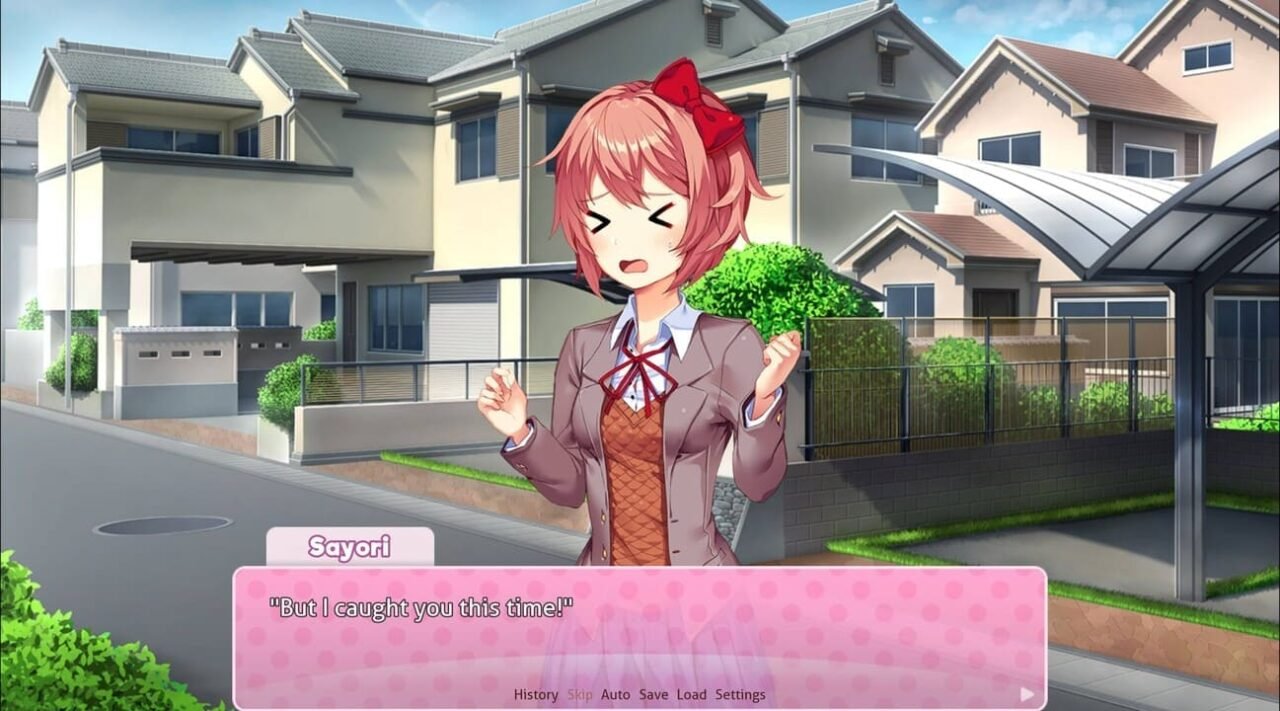
Sayori is quick to catch up with you on the way to school to make sure you’re heading toward the club.
Each character has a distinct personality that really starts to show once you share your first poem. The specific words you pick for your poems actually matter: they determine which girl responds best to you, letting you lean into their specific likes and dislikes to move the story forward.

The game begins to break down as the literature club’s hidden secrets start to bleed into the menus.
The music is excellent and does a lot of the heavy lifting when it comes to the game’s mood shifts. While most visual novels have separate “routes” that lead to different endings, DDLC is much more creative. It weaves those paths together to reach a single, cohesive true ending that really sticks with you.
Doki Doki Literature Club Verdict
Doki Doki Literature Club! starts off looking like a standard dating sim, but it quickly turns into something much more memorable. The poem-writing mechanic is a clever way to get you invested in the characters before the game starts pulling the rug out from under you.
The twists are genuinely surprising and add a ton of tension to what looks like a charming school story. By the time you reach the true ending, it is clear that this isn’t just another visual novel: it’s a unique experience that uses the medium in ways most games wouldn’t dare.
Doki Doki Literature Club TLDR
Doki Doki Literature Club! (PC)
Doki Doki Literature Club! combines charming art, a seamless interface, and memorable music with a dynamic narrative shaped by player choices. Unexpected twists and a cohesive true ending create a powerful impact.
It remains a compelling experience for visual novel fans on PC.