
Introduction: The Dawn of a Dream
On September 9, 2024, North America celebrates 25 years since the Sega Dreamcast burst onto the scene, its ethereal startup chime, crafted by Oscar-winning composer Ryuichi Sakamoto, known for film scores like The Last Emperor and Merry Christmas, Mr. Lawrence, echoing like a promise of gaming’s boundless future. With its sleek, futuristic design and iconic spiral logo, conceived by visionary developer Kenji Eno, the Dreamcast was not just a console. It was a bold declaration of what interactive entertainment could become.
Picture a teenager in 1999, plugging in their Dreamcast for the first time, the glow of the orange spiral on the screen igniting a sense of wonder. This was no ordinary gaming machine. It was a portal to a new era.
Though its commercial life was tragically brief, the Dreamcast’s influence reverberates through gaming history. Its pioneering features, from online connectivity to innovative accessories like the Visual Memory Unit (VMU), and its unforgettable library of games left an indelible mark. As we commemorate this milestone anniversary, we honor a console that dared to dream big, inspiring generations of gamers and developers. Join us as we revisit the Sega Dreamcast, a machine ahead of its time whose legacy still burns bright.
Dreamcast: A Technical Powerhouse
At the core of the Sega Dreamcast lay a revolutionary design rooted in Sega’s NAOMI architecture. This was not a mere adaptation. The Dreamcast was engineered to mirror the power of the arcade, delivering those high-end experiences directly to the living room. Games like Crazy Taxi, with its frenetic urban chaos, and Marvel vs. Capcom 2, with its dazzling 3v3 battles, felt indistinguishable from their arcade counterparts. This was a feat that thrilled players accustomed to the power of coin-op cabinets.
The technical foundation for this performance was a silicon beast. Under the hood, the Dreamcast featured a Hitachi SH-4 SuperH RISC processor running at 200 MHz, capable of 360 million instructions per second. An NEC PowerVR2DC chipset handled the visuals, pushing 3 million polygons per second with effects like bump mapping and anti-aliasing. With 16MB of system RAM and a dedicated Yamaha sound processor capable of 64 simultaneous audio channels, the machine was built to ensure it would not forget things during intense gameplay.
The Dreamcast’s innovation extended to its groundbreaking Visual Memory Unit (VMU). More than a memory card, the VMU was a miniature handheld device with its own LCD screen, buttons, and D-pad. It transformed gameplay in ways that felt futuristic. In Sonic Adventure, players could raise virtual Chao pets on the VMU, feeding and training them on the go. This was a novelty that felt like carrying a piece of the game in your pocket. In Resident Evil Code: Veronica, the VMU displayed real-time health and inventory stats, letting players manage resources without pausing. Zombie Revenge took it further by allowing players to collect in-game items that appeared directly on the VMU screen, adding a layer of portable interactivity.
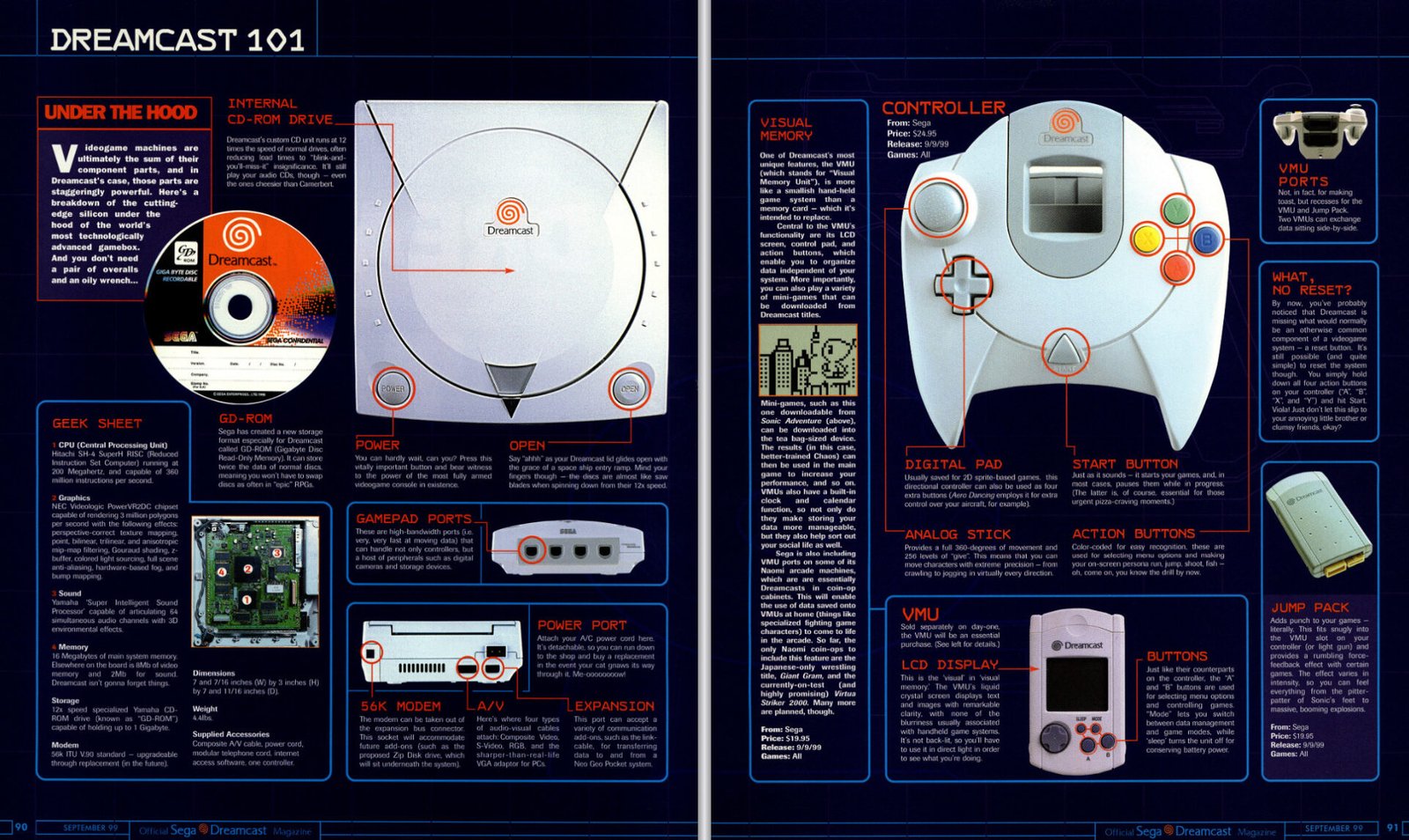
No overalls or oily wrenches required to appreciate this cutting-edge architecture.
This seamless blend of hardware and software showcased Sega’s commitment to pushing boundaries. Its proprietary 1GB GD-ROM discs offered greater storage than standard CDs, which enabled richer and more expansive game worlds. A built-in 56k modem made it a pioneer of online gaming, while four controller ports encouraged immediate multiplayer play. Even the controller itself was ahead of its time. The analog stick offered 230 levels of movement for extreme precision. Its Hall-Effect thumbstick was resistant to drift long before modern analogs, underscoring Sega’s forward-thinking design. This technical foundation made the Dreamcast a standout, blending arcade fidelity with home console innovation to redefine gaming.
Arcade-Perfect Ports: Bringing the Arcade Home
The NAOMI architecture was not just a technical flex. It was a total game changer that brought the arcade experience into your living room. In the late 1990s, arcades were the absolute pinnacle of gaming with their vibrant cabinets and cutting edge hardware. The Dreamcast effectively erased that divide by delivering ports so faithful they felt like you had teleported a coin op machine right into your home.
- Crazy Taxi: This title threw players into a sun soaked, chaotic cityscape with punk rock blaring as they swerved through traffic to beat the clock. Its arcade-perfect port captured every heart pounding moment from drifting around corners to earning tips with daring stunts.
- Marvel vs. Capcom 2: A massive love letter to fighting game fans featuring a roster of 56 characters. The Dreamcast version replicated the fluid animations and precise controls of the arcade, making it a tournament favorite and a living room legend.
- The House of the Dead 2: This staple of the arcades retained its blistering performance on the Dreamcast, proving that home consoles could finally handle high end light gun shooters without compromise.
- Confidential Mission: This title blended the light gun gameplay of Virtua Cop with a high tech spy thriller flair. Players took on the role of secret agents, tackling dangerous missions with combat and gadgets. It offered a strategic twist on the standard arcade shooting formula.
- Soulcalibur: This game set a new standard for 3D fighters with weapon based combat and breathtaking visuals. Characters like Nightmare and Ivy moved with a level of grace and detail that made it a genre defining masterpiece.
Exclusive Titles: A Library of Visionaries
While arcade ports showcased the Dreamcast’s power, its exclusive titles proved its soul. These games were not just entertainment. They were bold experiments that pushed the boundaries of design, storytelling, and immersion, cementing the Dreamcast as a haven for creative innovation.
- Quake III Arena: This title pushed the console’s online capabilities to the limit. It offered fast paced multiplayer that rivaled the PC version. Its smooth netcode and vibrant arenas made it a pioneer for console shooters.
- Sonic Adventure: Sega’s iconic mascot made a true 3D debut here. Players raced through vibrant worlds like the sunlit beaches of Emerald Coast. The Chao Gardens added a layer of charm by letting players raise virtual pets on the VMU while on the go.
- Shenmue: This was a revelation that pioneered open world gaming. Players followed Ryo Hazuki through a living city where NPCs followed daily routines. Its blend of RPG elements and cinematic storytelling set a template for modern epics.
- Sword of the Berserk: Guts’ Rage: Based on the famous manga, this game delivered brutal hack and slash action exclusive to the system. Its dark world and relentless combat earned it a massive cult following.
- Resident Evil Code: Veronica: Initially exclusive to the Dreamcast, this title elevated survival horror with haunting visuals and a complex story. “For Resident Evil 3, we lowered the bar a bit and wanted to make a game for the core fans. Code: Veronica, which isn’t a numbered title, deserved more to be a numbered one,” creator Shinji Mikami said, noting that corporate politics at Capcom influenced its status. The VMU provided real time health and inventory stats. This added a layer of immersion to every zombie encounter without needing to pause.
- Blue Stinger: This game blended survival horror with sci fi camp. Its quirky charm and detailed environments made it a unique gem beloved by fans for its offbeat style.
Online Pioneering: Dreamarena, DLC, and the Future
The Dreamcast did not just play games. It connected them to the world. With a built-in 56k modem, it was the first console designed for online gaming, launching Dreamarena to bring players together. Phantasy Star Online, the world’s first console MMORPG, let adventurers team up across continents to battle alien creatures, offering a glimpse of gaming’s connected future.
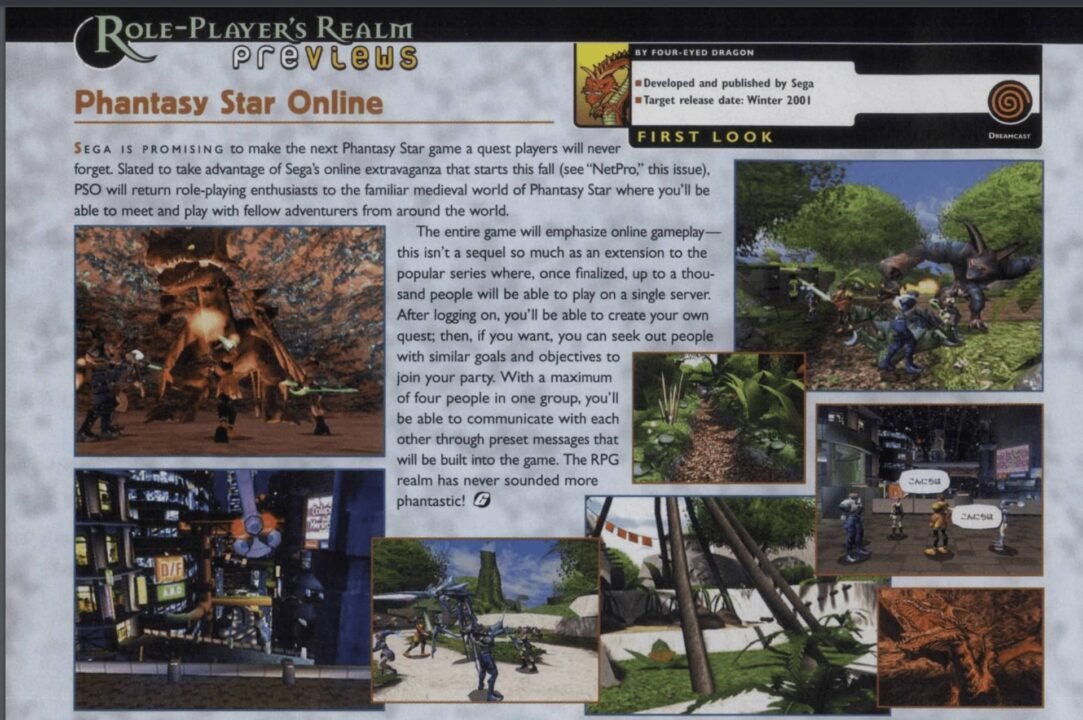
Medieval fantasy meets dial-up modems for the ultimate digital quest.
Sega went further by pioneering downloadable content with free add-ons like new Chao Gardens and character skins for Sonic Adventure 2. This innovation, now a cornerstone of gaming, began as a gift to Dreamcast players. When broadband emerged, the console’s modular design allowed users to swap the 56k modem for an Ethernet adapter, keeping it cutting edge.
In Japan, the DreamEye peripheral introduced video messaging, letting players send pictures and clips via the console, a precursor to modern social features. These advancements positioned the Dreamcast as a visionary, shaping the connected gaming landscape we know today (Classic Game Room, 2014).
A Brief But Lasting Impact
Despite its brilliance, the Dreamcast’s commercial run ended in 2001 as a casualty of multiple forces. The PlayStation 2’s overwhelming hype, bolstered by its DVD playback and massive marketing, overshadowed Sega’s offering. The Sega Saturn’s earlier failure left Sega financially strained, limiting its ability to compete. Limited third-party support and piracy, enabled by the GD-ROM’s vulnerabilities, further eroded its market. Sega exited the console business to become a third-party developer, marking the end of an era.
Yet the Dreamcast’s influence endures. Its online focus laid the groundwork for modern multiplayer ecosystems. Shenmue inspired open-world giants like Red Dead Redemption. Its arcade ports made high-end gaming accessible, while its experimental spirit lives on in indie titles and innovative console designs. The Dreamcast did not just compete. It reshaped gaming’s future.
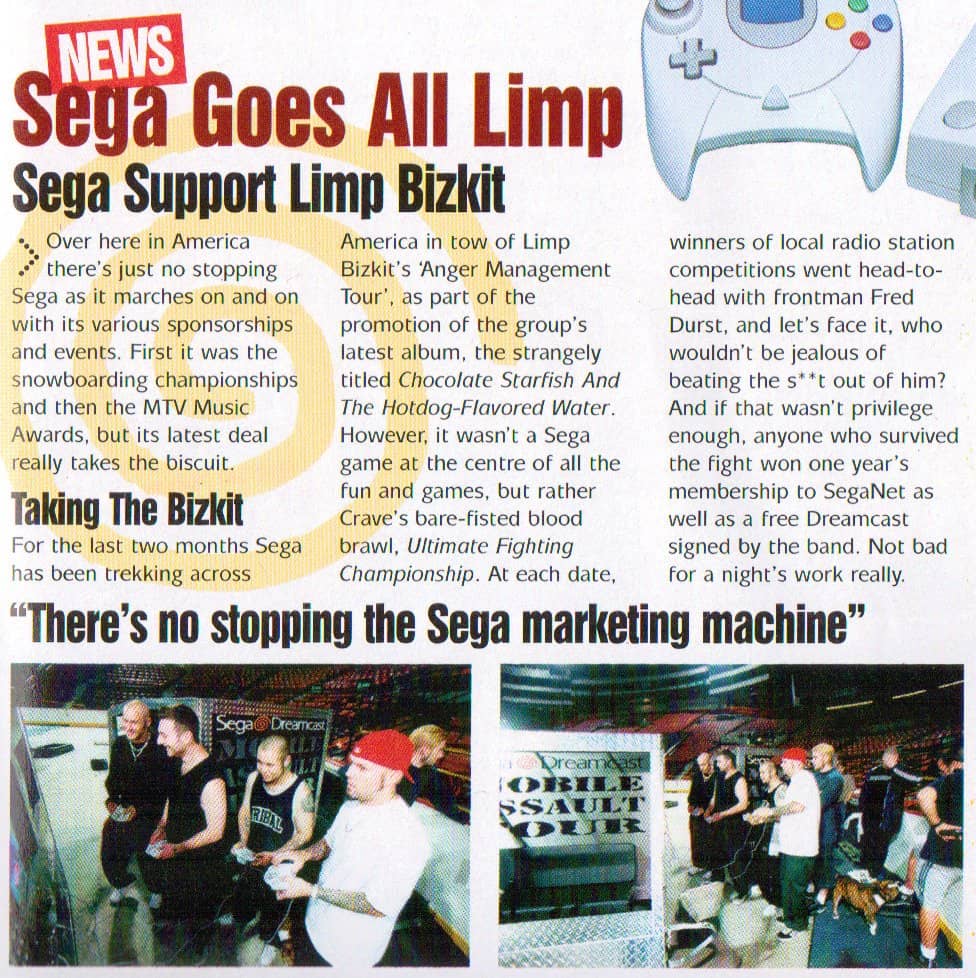
Beating Fred Durst in UFC was a small price to pay for a free year of SegaNet.
Conclusion: A Dream That Lives On
Twenty five years after its debut, the Sega Dreamcast remains a beacon of innovation. It gave us online gaming, DLC, and a library of titles that still captivate today. Its Visual Memory Unit turned memory cards into portable adventures, and its NAOMI architecture brought the arcade experience home without compromise. Though its life was short, its impact is eternal.
Today, the Dreamcast thrives in the hearts of fans. Homebrew developers craft new games, and communities release fan made mods and ports. Picture a Dreamcast humming in a collector’s setup, its orange spiral logo glowing as a new indie title loads. It is a testament to its enduring spirit. Happy 25th anniversary, Dreamcast. Your dream never faded.
References
- Sakamoto, R. (2009, November 17). Ryuichi Sakamoto – Merry Christmas, Mr. Lawrence. YouTube. https://youtu.be/LGs_vGt0MY8
- Archipel. (2023, December 22). Memories of Kenji Eno. YouTube. https://www.youtube.com/watch?v=S-6dNPYltr0
- Yarwood, J. (2024, January 15). Who Created Dreamcast’s Logo? We Spent A Year Trying To Find Out. Time Extension. https://www.timeextension.com/features/who-created-dreamcasts-logo-we-spent-a-year-trying-to-find-out
- Elk, B. (2024, September 9). The Sega Dreamcast turns 25 years old today (in North America). SEGAbits.com. https://segabits.com/blog/2024/09/09/the-sega-dreamcast-turns-25-years-old-today-in-north-america/
- Blakely, A., & Gattuso, E. (2024, May 6). Hall-Effect Joysticks: How do they work and how will they eliminate joystick drift?. iFixit. https://www.ifixit.com/Wiki/Hall-Effect_Joysticks
- RQ87. (2016, May 21). Crazy Taxi playthrough (Dreamcast) (1CC). YouTube. https://www.youtube.com/watch?v=1-aX7Qentx8
- RQ87. (2014, May 9). Marvel Vs. Capcom 2 playthrough (Dreamcast) (1CC). YouTube. https://www.youtube.com/watch?v=i4El-7Skmgw
- YouTube. (2022, April 29). House of the Dead 2 Dreamcast (Captured Retrotink 5x pro, RGB Scart 480p, Razer Ripsaw HD 4k). YouTube. https://www.youtube.com/watch?v=0asOr1qn2L8
- Bates, K. (2021, September 6). Confidential Mission (Dreamcast) Playthrough. YouTube. https://youtu.be/79RUksh74nI
- Video Game Showcase. (2024, June 7). How DREAMCAST Games Actually Look! | Sega Dreamcast Showcase. YouTube. https://www.youtube.com/watch?v=A8QtLp_HtfU&t=373s
- Official Sega Dreamcast Magazine. (1999, September 1). Dreamcast 101. Official Sega Dreamcast Magazine, (1), 90–91.
- Silentwulf A/V. (2023, June 25). Quake III Arena (Longplay) SEGA Dreamcast. YouTube. https://www.youtube.com/watch?v=Li7TLGxeWvo
- Video Game Showcase. (2024, June 7). How DREAMCAST Games Actually Look! | Sega Dreamcast Showcase. YouTube https://www.youtube.com/watch?v=A8QtLp_HtfU&t=1328s
- cosmaty. (2012, October 9). Shenmue – [Dreamcast] – Gameplay. YouTube. https://www.youtube.com/watch?v=WNrMuTu1EXc
- Game Archive – No Commentary Gameplay. (2016, November 16). Sword of the Berserk: Guts’ Rage – Dreamcast Longplay. YouTube. https://www.youtube.com/watch?v=KhEvX2siwfs
- Longplay Archive. (2021, August 2). Longplay of Resident Evil – Code: Veronica. YouTube. https://www.youtube.com/watch?v=gtG_z7ufEaA
- God Games, J. (2013, March 28). Blue Stinger – Gameplay Dreamcast HD 720P. YouTube. https://www.youtube.com/watch?v=kS–YOM4Foc
- Archipel. (2020, October 15). Shinji Mikami, Part 1: The birth of the survival horror game. YouTube. https://www.youtube.com/watch?v=NKYX3GstHlw&t=1188s
- Four-Eyed Dragon. (2000, July). Role-Player’s Realm Previews: Phantasy Star Online. GamePro, 142, 106–106.
- Classic Game Room. (2014, June 20). Classic Game Room – SEGA DREAMEYE & VISUAL PARK review for Dreamcast. YouTube. https://www.youtube.com/watch?v=kz3sOq506rM